
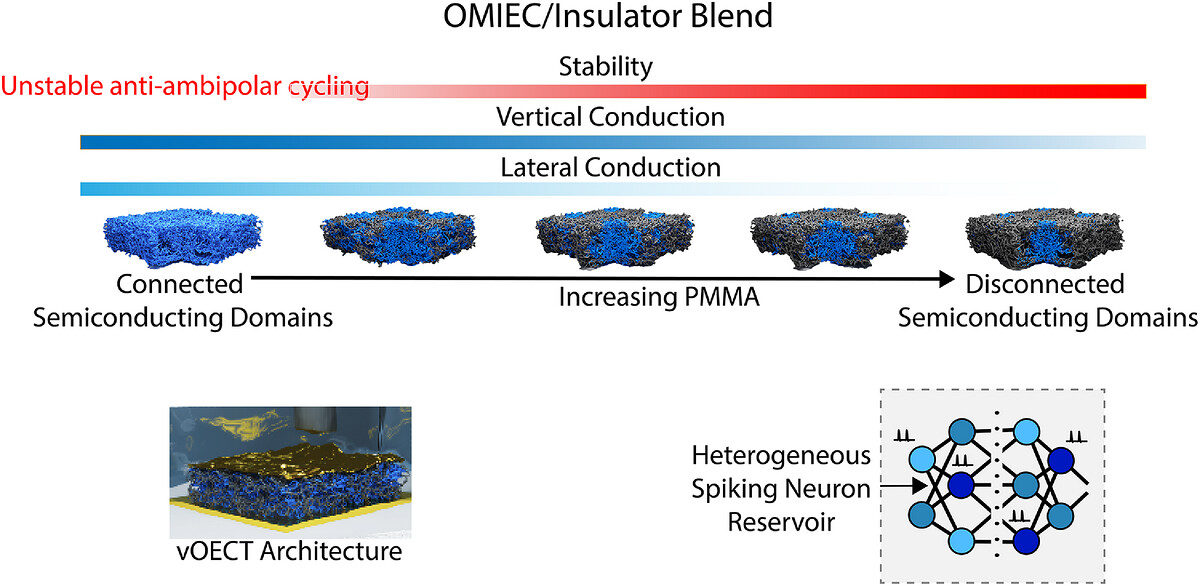
Zachary Laswick, a PhD student in Biomedical Engineering, is first author of “Blending With Insulating Polymers Enables Stable Anti-Ambipolar Characteristics in n-Type Organic Mixed-Conductors for Heterogeneous Spiking Neurons,” published online October 31 in Advanced Materials. It’s open access.
On its own, the semiconducting polymer used here swells as the transistors run, and the resulting damage makes them fail after the first few cycles. Blending in PMMA, an insulating polymer, forms a sturdy framework that limits the damage but still lets ions through. Changing the blend ratio also tunes how each artificial neuron built from the transistors fires, without optimizing the devices’ geometry. That matters because mammalian neurons are diverse in a way today’s brain-inspired hardware is not.
Anti-ambipolar transistors feature a drain current that moves from OFF to ON to OFF states with increasing gate bias. This property is intrinsic to many n-type conjugated polymers. However, limited stability and speed in these n-type organic materials prevents the design of integrated, tunable, and heterogeneous neuromorphic systems. We offer a polymer blending approach, of n-type OMIEC P(gNDI-gT2) with insulating PMMA, to yield mechanically stabilized, anti-ambipolar organic electrochemical transistors (OECTs) with tunable ionic-electronic transport. This blending allows low-power, fast-spiking heterogeneous Hodgkin–Huxley neurons, enabling biomimetic frequency deconvolution and reservoir computing, which are key primitives for realizing energy-efficient neuromorphic spiking neural networks.
Zach’s co-authors from the group are postdocs Catherine Beaumont and Priscila Cavassin, alumni Dilara Meli and Giovanni Maria Matrone, and Jonathan Rivnay. The other authors are Ariel Lifer, Liad Hayoun, and Gitti Frey of the Technion in Israel; Zeinab Hamid of the University of Oxford; Iain McCulloch of Oxford and Princeton University; William Dupont of Université Laval in Canada; and Lincoln Lauhon, also of Northwestern.
This work follows Zach’s 2024 paper in Nature Communications, which used anti-ambipolar transistors to mimic a pathway in the retina.
Congratulations, Zach!